Case study
ResNimbus
Diagnosing cloud cover from AI weather models, calibrated across the domain shift.
- Physics-residual ML
- Domain shift
- Spectral robustness
- Calibrated uncertainty
- ResNimbus hackathon result2nd place, Climate Informatics 2026
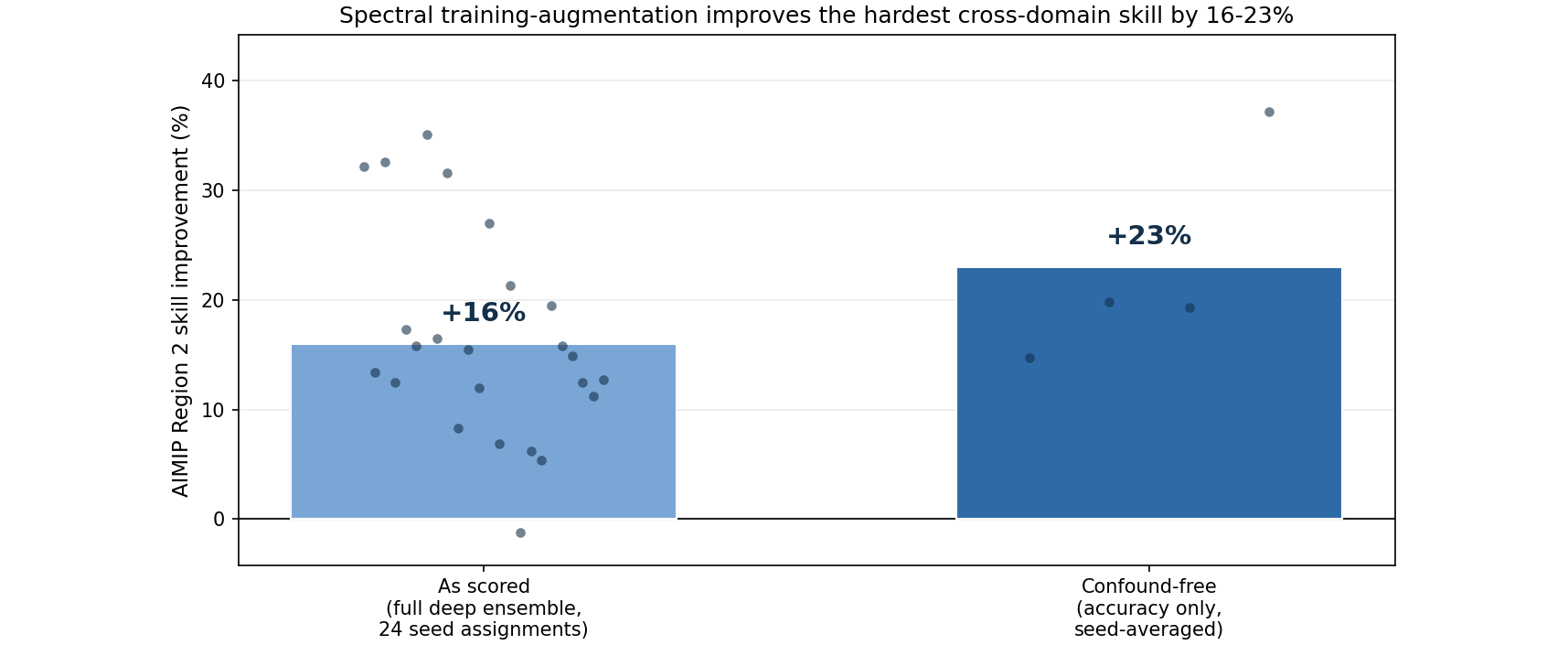
- ResNimbus skill improvement+16–23% cross-domain skill
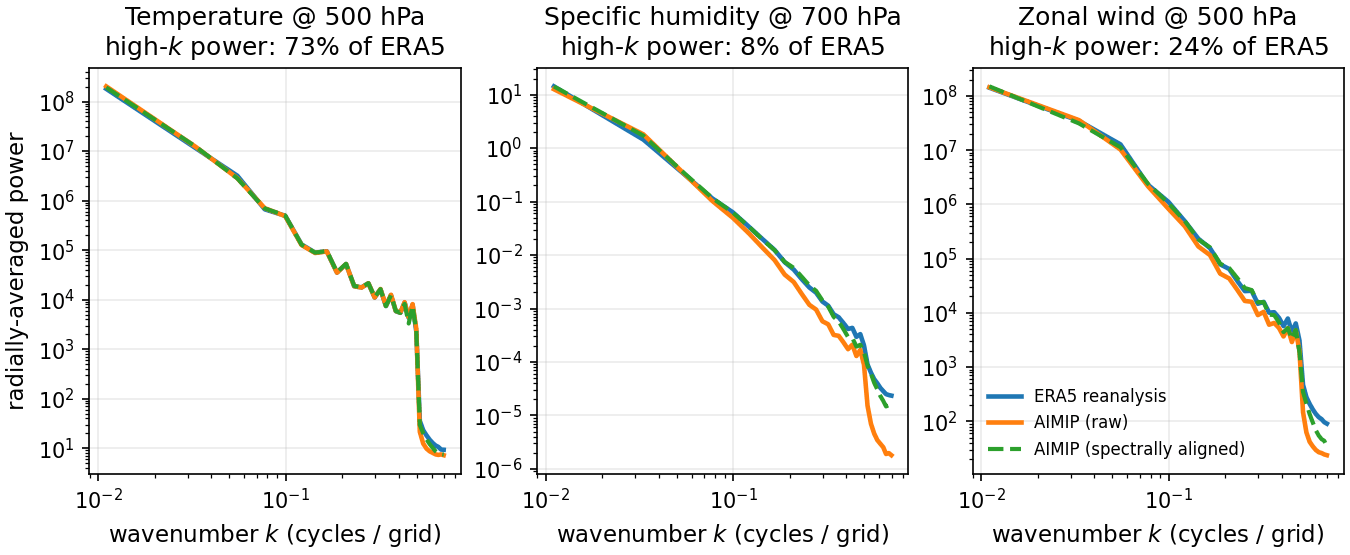
- High-wavenumber power retained on AI-model inputs (humidity vs temperature)8% vs 73%
The problem
Cloud cover is one of the largest single sources of uncertainty in climate projection, and AI weather models (GraphCast, Pangu, FourCastNet) are moving into operational forecasting without ever having been trained to get clouds, or small scales, right. That poses a sharp, practical question: can cloud cover be diagnosed directly from an AI model’s output fields, even though those fields were never optimised for it? ResNimbus is a focused study of that question, and of the single physical insight that turns the answer into yes.
The obstacle is a domain shift. A network trained on ERA5 reanalysis meets out-of-distribution inputs the moment it runs on AI-model fields, because those models are trained with regression losses and are therefore spectrally blurred: they systematically shed high-wavenumber power. The blur is not uniform. Temperature passes through it almost intact; specific humidity, the field that governs where cloud forms, keeps only a sliver of its high-wavenumber power by comparison (8% vs 73%, humidity against temperature). The variable that matters most for clouds is the one the emulators degrade most, and that is precisely why naive transfer fails.
Approach
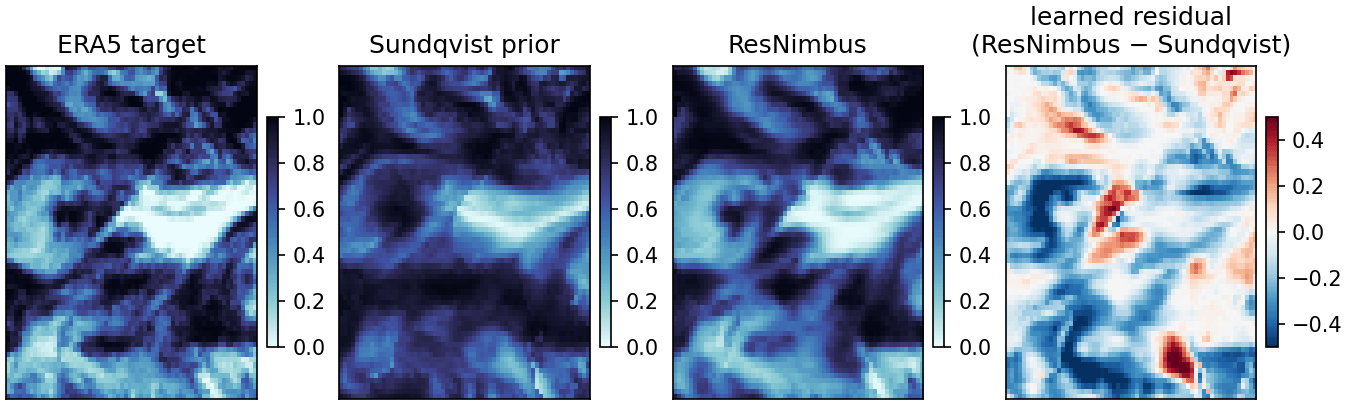
Rather than treat the blur as noise to clean up, ResNimbus is designed around it. During training each ERA5 input field is scaled toward the AI-model power spectrum, so the network learns to be robust to the high-wavenumber deficit it will meet at test time instead of being surprised by it. The model itself is a hybrid. A Sundqvist random-overlap diagnostic supplies a deterministic, interpretable first guess for cloud cover that degrades gracefully out of distribution, and an axial-attention U-Net learns only the correction to it. Because the residual has to model just what the physics gets wrong, it stays bounded under extrapolation instead of inventing structure. The inputs are climate-invariant by construction (relative humidity rather than specific humidity, vertical gradients, boundary-layer stability indices, latitude-only position encoding) so that what the network learns in one region transfers to another.
The study is deliberately trained on ERA5 Region 1 only, holding the AI-model regions out entirely, so the reanalysis-to-AI-model transfer is the genuine test rather than a quantity that in-domain tuning can flatter.
Results
Designing around the asymmetry is a measurable accuracy gain, not a calibration artefact. Spectral training augmentation improves the model on the hardest transfer configuration by +16–23% cross-domain skill, averaged over every seed-to-member assignment in the deep ensemble so the number cannot ride a lucky draw. The lower bound is that honest ensemble average; a confound-free control that strips the inter-seed spread out entirely recovers the upper figure, positive in every fold. It buys this transfer at no meaningful cost to in-domain skill, a deliberate trade in favour of generalising across input domains rather than squeezing the one region it was trained on. This repository develops the methodology behind the entry that took 2nd place, Climate Informatics 2026.
The calibration story is reported as squarely as the skill. Under the AI-model shift a single model becomes over-confident, its predictive distribution too narrow, and the study measures that rather than papering over it.
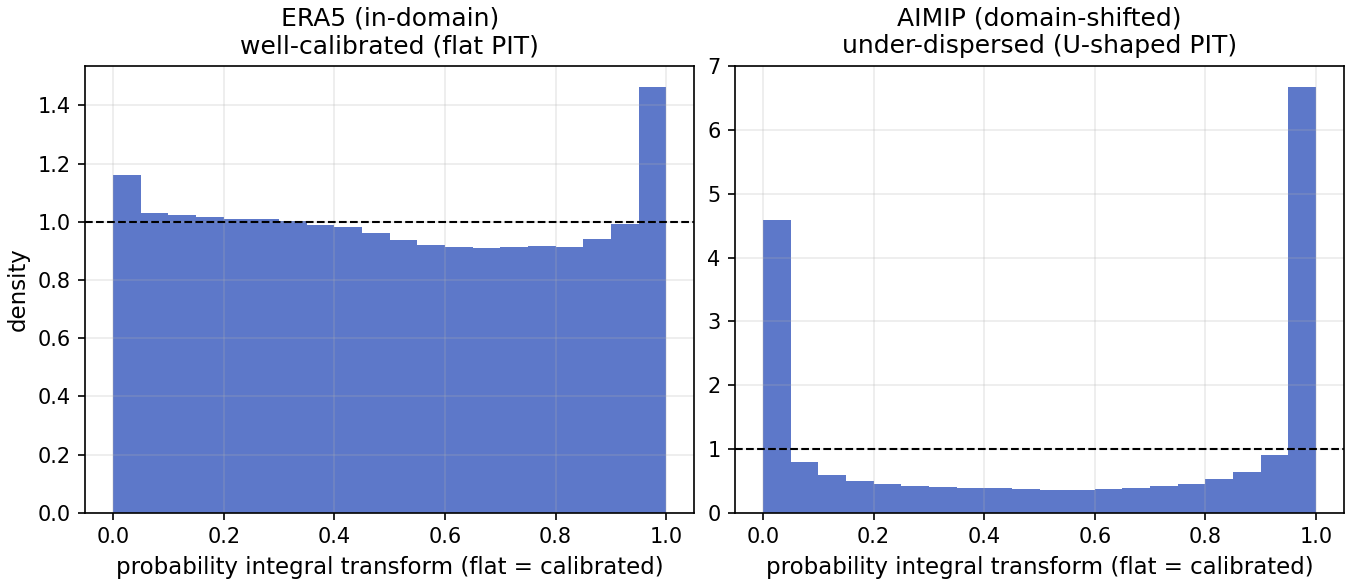
That measured under-dispersion is the motivation for scoring the AI-model forecast as a small multi-model ensemble: the spread between AI weather models supplies the dispersion a single deterministic network lacks, and the training objective rewards getting that spread right. Reporting the failure honestly is the point, because knowing where a model’s uncertainty stops being trustworthy is the deliverable, not a footnote to hide.
> ENGINE_ROOM The hybrid, the Beta head, and the spectral mechanism
The predictive head emits a Beta distribution because cloud cover lives on the unit interval with probability mass piled at the clear and overcast extremes, so a density fits the support where a Gaussian would spill off both ends. All of the model’s uncertainty comes from this head; there are no post-hoc spread adjustments. It is trained with negative log-likelihood together with an almost-fair CRPS term, which is what makes the in-domain predictive distribution genuinely calibrated rather than merely sharp.
Skill is scored against the Sundqvist baseline as
so zero is the physics baseline and higher is better, with a latitude-weighted error over the reanalysis regions and a fair CRPS over the multi-model ensemble. The spectral augmentation is applied stochastically during training rather than to every batch, so the network sees both blurred and sharp inputs and learns robustness without collapsing onto either regime. A cheaper test-time variant that aligns AI-model inputs back toward the ERA5 spectrum before inference is also provided, but it adds essentially nothing once the network has been trained to expect the deficit, which is itself the cleanest confirmation that the training-time mechanism is the one doing the work.
Approaches that did not survive are reported as part of the study, not buried: a conditional diffusion ensemble and a Swin-Transformer backbone both underperformed the physics-residual hybrid at this resolution and were cut to keep the question focused.
What this demonstrates
A physics-residual hybrid that stays accurate and calibrated across a real distribution shift, with the transfer traced to one named, testable mechanism rather than to scale. The design choice, training the network to expect the spectral deficit it will meet, is validated by a confound-free control and reported alongside its calibration failure rather than in place of it.
Calibrated model risk under domain shift, quantified. The study measures exactly where a single model’s uncertainty stops being trustworthy off its training distribution, and shows how an ensemble restores the missing spread, which is the discipline any desk relying on a model outside its fitted regime has to impose before it trusts the tails.