Case study
ForeshoreCast
Physics-based shelling forecasts for the Gulf Coast, running unattended in production.
- Lagged Deposition Model
- LLM narrative generation
- Cron-scheduled ops
- Consumer product
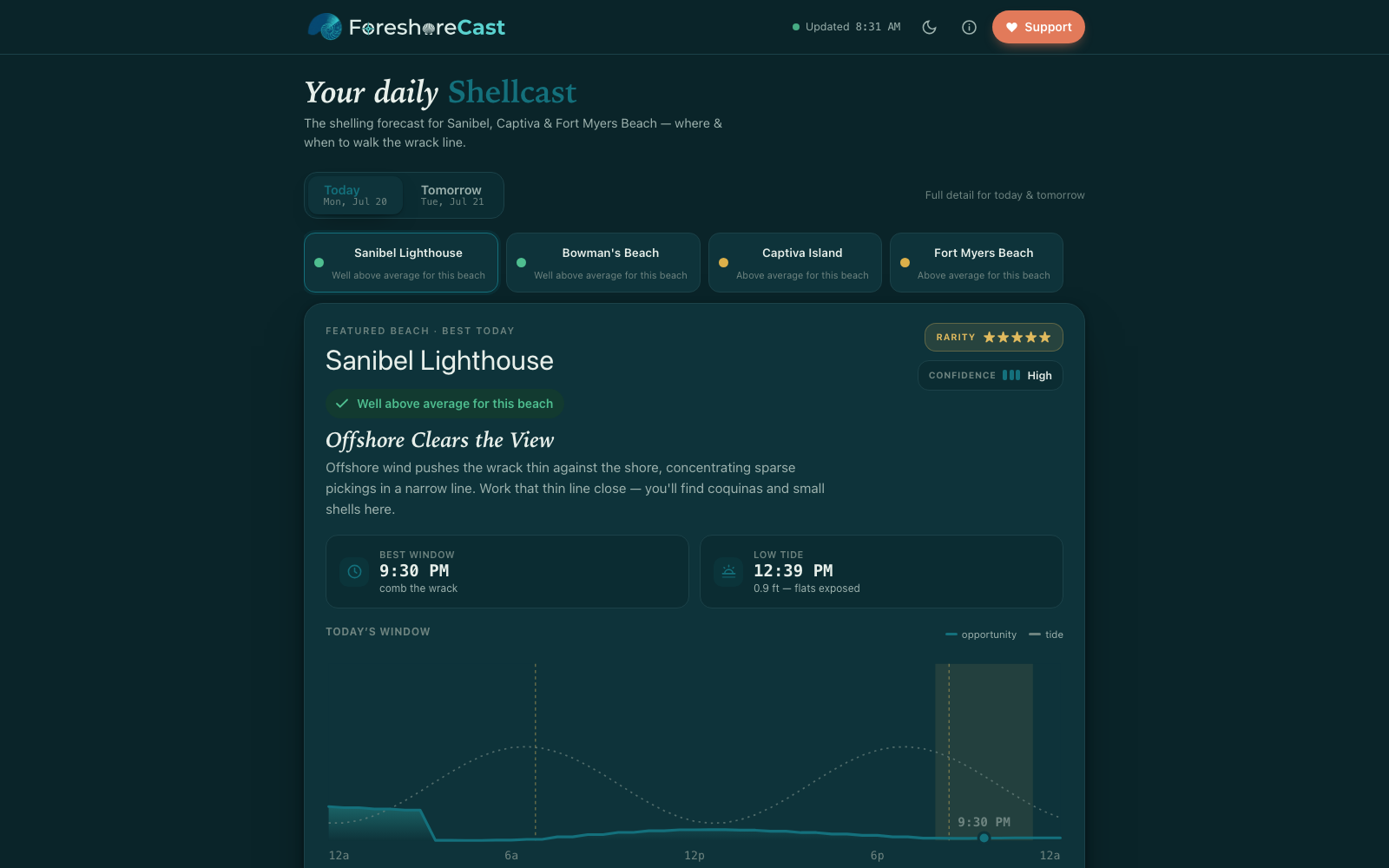
- Southwest Florida beaches forecast4
- Automated forecast pipeline cadence3/day, DST-aware
The problem
Good shelling on Sanibel and the neighbouring Gulf Coast beaches is not random: shells accumulate on the wrack line after a specific sequence of wave energy, wind direction, and tide, and locals learn to read that sequence by feel. ForeshoreCast encodes the sequence directly, as a physics-based forecast of when and where the shelling will be best, delivered as a plain daily read rather than a chart to interpret.
How it works
The core is a custom Lagged Deposition Model: recent wave energy, weighted toward the last few days since deposition lags the sea state that caused it, combines with onshore wind and swell period into a deposition index, and each beach’s index is then read against its own tide exposure to flag the best combing window and the day’s rare-shell odds. An LLM turns that index into the day’s narrative, writing from each beach’s percentile standing rather than its raw score, so the text never overclaims a middling day.
What this demonstrates
A physics-based scoring model wrapped in an LLM narrative layer and run as an unattended production service: a cron pipeline across 4 beaches, 3/day, DST-aware, monitored by an external healthcheck and deployed by a plain git push. The point is not the model’s sophistication but that ingestion, scoring, narrative, and upload have kept running on their own since launch.